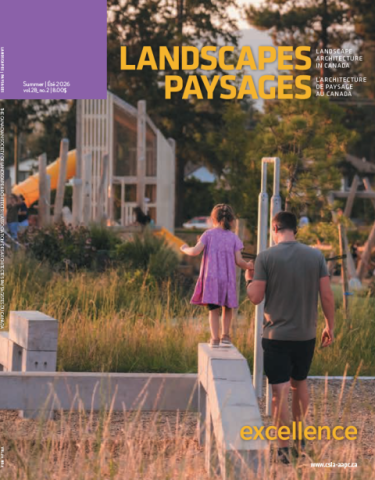
"Turn the pages and behold! the 2026 CSLA Awards of Excellence. Review these projects, reflect on your own. Enter and continue the discussion of advancing our profession while creating positive impacts on our world."
– Carol Craig, Jury Chair



Welcome to the CSLA Resource Library! Explore a wide range of landscape architecture-related research, reports, tools, videos and more—searchable by keyword, topic or type.
Have a resource you'd like to see included? Contact our team to share your suggestion.
2026 – Landscapes | Paysages Magazine
CSLA/AAPC
CSLA
"Turn the pages and behold! the 2026 CSLA Awards of Excellence. Review these projects, reflect on your own. Enter and continue the discussion of advancing our profession while creating positive impacts on our world."
– Carol Craig, Jury Chair
2026 – Webinar
CSLA/AAPC
Two complementary perspectives—one from project delivery, the other from design leadership—come together to examine the Port Lands Flood Protection Project, one of the most ambitious landscape infrastructure and climate adaptation initiatives in Canada.
Together, the presenters will reflect on how landscape architects can lead complex infrastructure projects that integrate flood protection, ecological restoration, and urban revitalization—demonstrating the critical role of landscape architecture in addressing climate change, environmental remediation, and quality of life in cities.
This webinar is offered through landADAPT: A continuing education program to promote building capacity through professional development opportunities for Canadian landscape architects, supported by Natural Resources Canada’s Climate Change Adaptation Program.
2026 – Webinar
CSLA/AAPC
Note: This was a bilingual event held in both English and French. Complete captions in either language are available in the video settings.
Two complementary perspectives—one from project delivery, the other from design leadership—come together to examine the Port Lands Flood Protection Project, one of the most ambitious landscape infrastructure and climate adaptation initiatives in Canada.
Two expert perspectives—one rooted in ecological relationships, the other in professional practice—come together to examine how native plants can support biodiversity, pollinators, and resilient landscapes. From co-evolved plant–pollinator relationships to the realities of sourcing, design, and public acceptance, the session will examine how plant choices shape ecosystem function and long-term landscape performance, and connect theory, design intent, and implementation challenges.
This webinar is offered through landADAPT: A continuing education program to promote building capacity through professional development opportunities for Canadian landscape architects, supported by Natural Resources Canada’s Climate Change Adaptation Program.
2026 – Paper
CSLA/AAPC
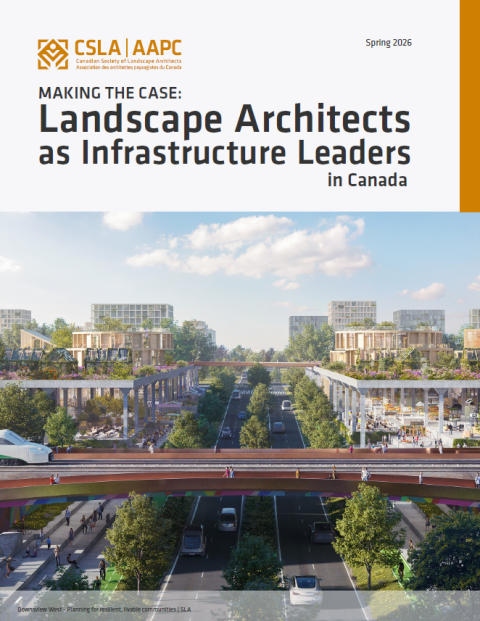
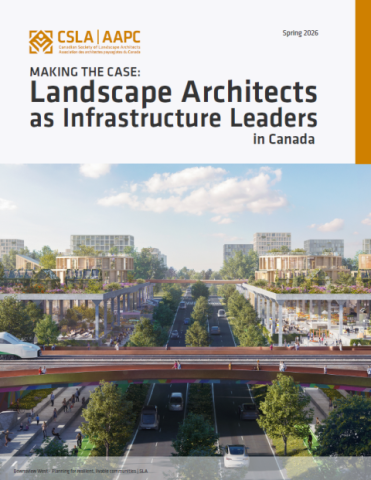
The CSLA's Infrastructure Brief makes the case for landscape architects as essential leaders in Canada's infrastructure transformation. The brief examines how the profession addresses three interconnected federal priorities: housing, mobility, and climate defence. Featuring Canadian case studies that demonstrate nature-based solutions, systems thinking, and human-centered design, the brief demonstrates how early involvement of landscape architects in policy and design delivers more livable, sustainable, and resilient communities.
2026 – Webinar

CSLA/AAPC
To address the impacts of climate change and enhance urban biodiversity, the City of Vancouver is beginning to build a network of blue-green systems across the city. The presentation is a case study of the project, with team members presenting on planning, design, construction, and on-going maintenance.
This webinar is offered through landADAPT: A continuing education program to promote building capacity through professional development opportunities for Canadian landscape architects, supported by Natural Resources Canada’s Climate Change Adaptation Program.
2025 – Webinar
CSLA/AAPC
Mini Forests, also known as Tiny Forests or Miyawaki Forests, are small-scale, densely planted, native forests consisting of trees, shrubs, and herbs. The key components of the method involve: 1) robust soil amendments, and 2) sixty centimetre on-centre tree and shrub planting of locally native, climax species.
2025 – Webinar
CSLA/AAPC
This webinar will introduce key insights from the Landscape Carbon Benchmarking Study - commissioned by the City of Toronto and prepared by DTAH - which establishes benchmarks for the carbon intensity of private urban development landscapes. By analyzing ten representative development sites in Toronto, the study quantified upfront emissions and sequestration, identified the most carbon-intensive assemblies, and demonstrated how alternative design decisions can meaningfully shift outcomes. The findings establish a reference point for both practitioners and policymakers, creating a shared framework for carbon-conscious design.
2025 – Webinar

CSLA/AAPC
This presentation explores how artificial intelligence is reshaping landscape architecture — accelerating design processes, expanding creative potential, and introducing new risks to mentorship, sustainability, and professional identity. Jeff Cutler, FCSLA, examines both the threats and opportunities AI presents, emphasizing how landscape architects can thrive by cultivating uniquely human skills like intuition, imagination, and critical insight. The session invites participants to explore AI thoughtfully, ensuring the profession evolves without losing its soul.
2025 – Webinar

CSLA/AAPC
This presentation covers:
What are microaggressions vs macroaggressions
What is workplace conflict
How these feed conflict in the workplace
Intention vs Impact
Why/how/when to address microaggressions as the target, offender, or bystander
2025 – Tool

UNESCO
"The UNESCO World Heritage List includes 1248 properties forming part of the cultural and natural heritage which the World Heritage Committee considers as having outstanding universal value.
These include 972 cultural, 235 natural and 41 mixed properties in 170 States Parties. As of October 2024, 196 States Parties have ratified the World Heritage Convention."
2025 – Tool

ICLEI
In the face of Canada’s escalating climate and housing challenges, communities across Canada need easy access to trustworthy data and climate information. Climate Insight is an online platform designed to meet this need. It provides a centralized source for communities to find the tools and data they need to advance low carbon, climate-resilient housing and infrastructure initiatives in their communities. Climate Insight is designed to ease the burden of data collection and tool selection fatigue by sourcing and centralizing the tools and data that are the most relevant to practitioners advancing low carbon, climate resilient housing and infrastructure in their communities. Climate Insight is actively being developed and mobilized through a collaborative, consultative process over the course of five years (2023-2028). New features and functionality will continue to be added to ensure our mandate of supporting the needs of communities.
2025 – Tool

National Centre for Truth and Reconciliation (NCTR)
The National Centre for Truth and Reconciliation (NCTR) is a place of learning and dialogue where the truths of Residential School Survivors, families and communities are honoured and kept safe for future generations. The NCTR educates Canadians on the profound injustices inflicted on First Nations, Inuit and the Métis Nation by the forced removal of children to attend residential schools and the widespread abuse suffered in those schools.