


CLIMATE ISSUE: Biodiversity loss; Increased precipitation; Increased stormwater runoff; Urban heat island effect | SECTOR: Green infrastructure; Landscape architecture; Policy development; Urban planning | STAGE: Adopted in 2009; Came into effect 2010; Authority for Green Roof Bylaw Repealed 2025 | TYPE OF ACTION: Policy development | TYPE OF SETTING: Urban
Project Overview
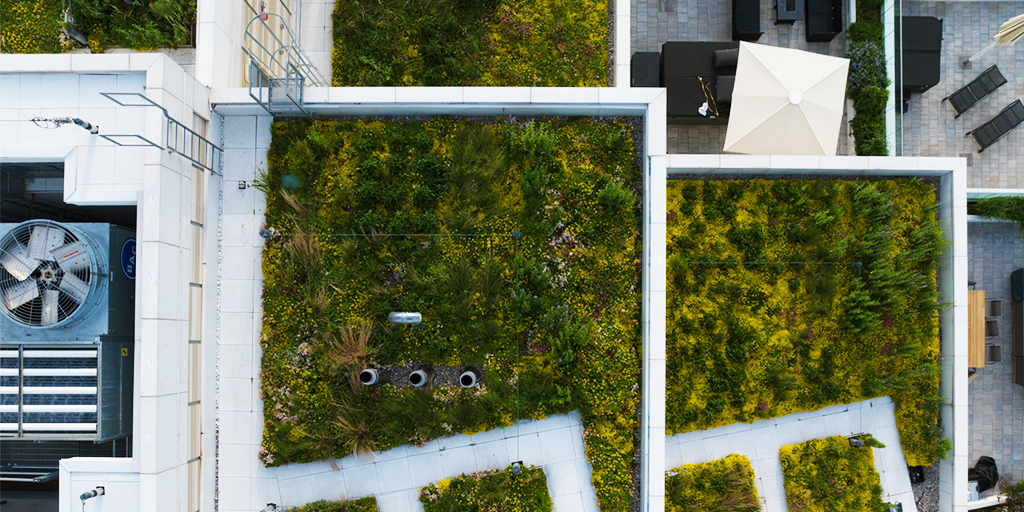
As one of the first municipal policies of its kind, the City of Toronto Green Roof Bylaw was a regulatory tool that established construction standards and mandated green roof requirements for new developments or building additions exceeding 2,000 m² in gross floor area. Between 2010 and 2025, the bylaw supported an estimated $50 million green roof design and construction industry, resulting in the installation of more than 1,200 green roofs across the city. The Bylaw advanced city-wide climate resilience and sustainable building objectives by strengthening stormwater management, reducing urban heat, and enhancing urban biodiversity and green space coverage in all new developments.
Location: Toronto, Ontario
Actors: City of Toronto (Council; City Planning (Environmental Planning, Policy, Strategic Initiatives, Policy and Analysis and Toronto Building); Province of Ontario (legislative authority); Toronto Metropolitan University (research), University of Toronto Daniels Faculty of Architecture, Landscape and Design, Green Roof Innovation Testing Laboratory (GRIT lab) (research); LiveRoof Ontario, Next Level Storm Water Management (Green roof suppliers)
Funding Agency(s) / Programs: City of Toronto
Issue: Impermeable urban surfaces; Lack of standardized design and construction requirements for green roofs; Loss of accessible and/or at-grade green space; Stormwater management
Action: The City of Toronto adopted the Green Roof Strategy (2006) followed by the enactment of the Green Roof Bylaw (2010), transitioning from incentive-based measures to mandatory requirements of vegetated roof coverage on all new large-scale developments
Results: Enabled the widespread implementation of green roofs across Toronto, supporting the installation of over 1,200 green roofs and economic growth associated with a dedicated green roof design and construction industry
Case Study Lead: City of Toronto
Project Background
To encourage the widespread implementation of green roofs on public and private buildings – largely driven by stormwater management objectives – the City of Toronto adopted the Green Roof Strategy, Making Green Roofs Happen, in 2006. At the time, early champions of these initiatives included Mayor David Miller and Deputy Mayor Joe Pantalone. In addition, strong support from City Planning and senior management proved critical, including leadership from Director Joe D’Abramo and Jane Welsh (Landscape Architect, and Project Manager of the Environmental Planning unit of Toronto City Planning).
Beyond internal leadership, external advocacy also played an important role, particularly from organizations such as Green Roofs for Healthy Cities. Key initiatives under the Strategy included a pilot financial incentive program, the integration of green roofs into municipal capital projects, and importantly, the use of a development review process to encourage green roof installation. The Strategy embedded green roof design within planning approvals, which resulted in a number of projects secured through zoning and site plan review by 2007.
During this time, the City also led complementary public education and professional training initiatives aimed at supporting broader uptake. The City also required new buildings constructed by municipal agencies to incorporate green roofs covering 50% of Available Roof Space, resulting in early installations across civic and cultural facilities that served as precedent-setting examples for wider industry adoption. Together, these early measures provided the necessary testing and capacity-building to enable the City to move from voluntary encouragement to regulatory implementation. With new legislative authority granted by the Province of Ontario under amendments to the City of Toronto Act in 2006, the City then transitioned from incentive-based measures to mandatory requirements, officially adopting Chapter 492, the Green Roof Bylaw in 2009.
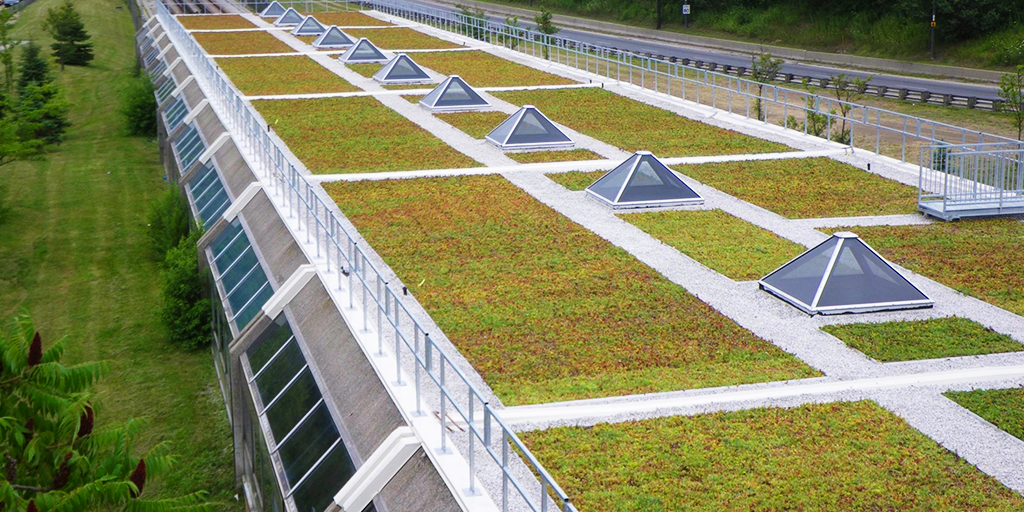
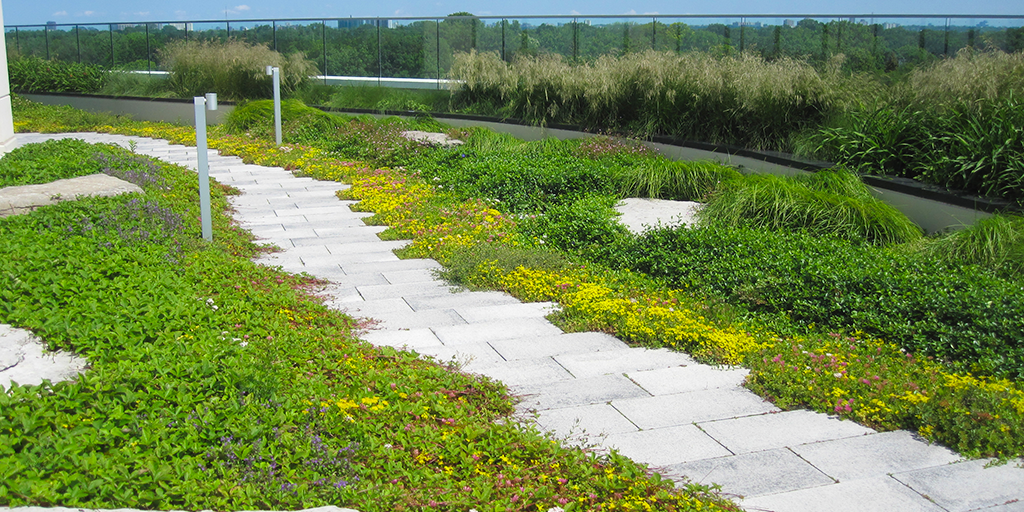
Toronto’s Green Roof Bylaw, defines a green roof as “an extension of an above grade roof, built on top of a human-made structure, that allows vegetation to grow in a growing medium and which is designed, constructed and maintained in accordance with the Toronto Green Roof Construction Standard.” A compliant green roof assembly includes, at a minimum, a root repellent system, drainage layer, filter layer, growing medium, and vegetation, all installed above a waterproof membrane. The Bylaw established a policy framework that formalized the construction standards and ensured consistent implementation across all new large-scale developments.
Understanding and Assessing Impacts
Prior to the adoption of the Green Roof Bylaw, the City of Toronto commissioned a team at Toronto Metropolitan University (known then as Ryerson University) to Report on the Environmental Benefits and Costs of Green Roof Technology for the City of Toronto (2005). This study was used to inform the 2006 Green Roof Strategy, demonstrating the economic, social and environmental benefits associated with the installation of green roofs at both the building and city-wide scale. The anticipated outcomes found in the study reinforced the rationale for the regulation, and guided the development of the technical standards and requirements.
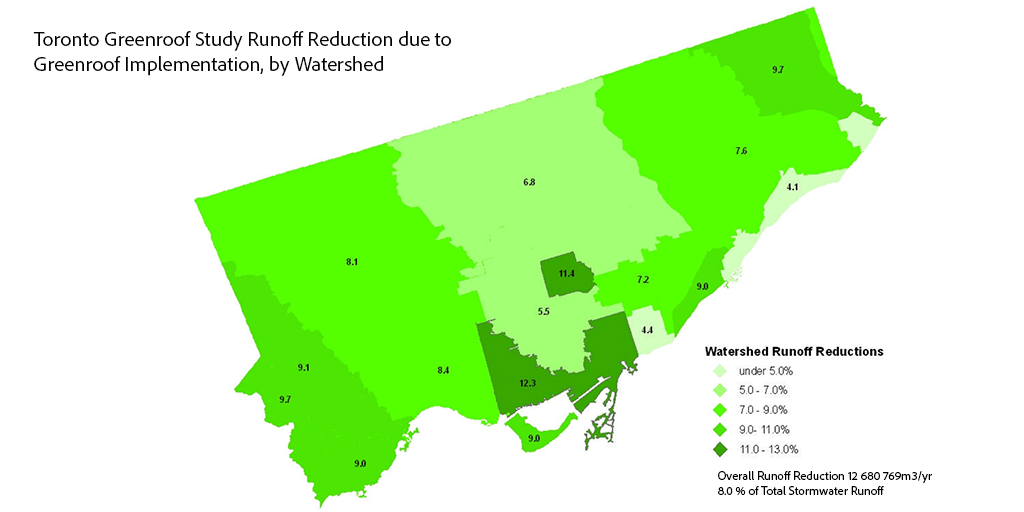
From a building performance perspective, the study found that green roofs helped reduce energy demand by moderating roof surface temperatures, improving thermal performance, and lowering heating and cooling loads, with additional benefits related to reduced greenhouse gas emissions. At the urban scale, green roofs were identified as effective tools for mitigating urban heat by cooling air temperatures and increasing vegetated surface area in dense urban environments. Stormwater retention represented a critical insight, as green roofs were found to improve capacity to retain rainfall, thereby reducing peak flows and alleviating pressure on stormwater systems, while also improving downstream water quality. The policy framework was further supported by the identified social benefits, including noise reduction, enhanced visual quality, and improved mental health and physical well-being associated with opportunities for urban agriculture, recreation, and increased access to nature, as well as overall nature-based beautification of urban infrastructure.
Use of Climate Information in Decision-Making
The policy was developed with a clear understanding of its environmental benefits and alignment with the City of Toronto’s broader climate resilience objectives. Grounded in research findings (from the Toronto Metropolitan University study and others) that confirmed that while other technologies can address stormwater and heat mitigation, green roofs uniquely and simultaneously deliver ecological benefits. These co-benefits were described in the Toronto Metropolitan University study as improved air quality through carbon sequestration and pollutant removal, and the support of biodiversity recovery through the creation of habitat for birds, pollinators, and other small urban wildlife species. These findings later informed the City’s Guidelines for Biodiverse Green Roofs and strengthened the technical standards incorporated into the Bylaw. Research from other institutions and input from technical experts, including groups such as the GRIT Lab, contributed critical applied knowledge on soil composition and plant selection, improving system performance and reinforcing ecological functions within the construction standards.
Toronto’s broader climate context has since evolved, with more direct integration of climate data into policy and planning. The City’s Resilience Strategy (2019) underscored the key pressures facing the city, including climate change, housing, mobility, and equity, and identified the Green Roof Bylaw specifically as positioning the city for greater resilience. More recent climate studies commissioned by the City, such as Toronto’s Current and Future Climate Report (2024) provide updated long-term climate projections documenting warming trends over the past 170+ years, with the ten warmest years on record occurring since 1998. Climate projections also indicate increasing frequency and intensity of extreme heat and precipitation events. These trends further reinforce the need for green infrastructure such as green roofs as integrated nature-based climate adaptation strategies across the city.
Identifying Actions
In addition to economic, social, and environmental analyses, the City of Toronto incorporated external input early in the drafting process to inform and justify the adoption of the Bylaw, with detailed focus on construction standards and technical considerations, and identification of areas of potential conflict. Using a model similar to that of building code processes, a technical advisory committee was formed to guide the development of the construction standard and the technical requirements, drawing on expert consultation to establish an integrated building permit review and compliance framework. In fact, collaboration across departments, industry actors, consultants, and political leadership was essential to the Bylaw’s success. The consultation process involved environmental groups, industry consultants, developers, and other practitioners to gather input on feasibility and structure. This process enabled transdisciplinary knowledge exchange for evidence-based policy development across design, construction, and planning fields including landscape architecture, engineering, and urban planning and design, as well as industry representatives, academic researchers, and municipal staff.
Engagement with developers early in the process was critical for identifying practical challenges and potential conflicts with zoning and other planning requirements to avoid unnecessary barriers to development and approval. Likewise, engagement with roofing contractors and industry actors helped the City assess industry capacity and identify potential barriers for installation and maintenance. The Bylaw was further refined through an iterative process to incorporate input and align with other planning tools, including mid-rise guidelines and tall building policies, where technical requirements were adjusted to avoid conflicting with preferred building typologies.
As a result, flexibility mechanisms were used to reduce development barriers while maintaining policy objectives. A cash-in-lieu provision allowed developers flexibility where physical installation was not feasible, with payments directed toward the City’s Eco-Roof Incentive Program, which supports green roof investments elsewhere in the city. The program eventually expanded eligibility to nonprofit organizations, schools, and other uses where compliance could be difficult. This process ensured that whether developers installed green roofs or paid cash-in-lieu, both mechanisms contributed to advancing city-wide climate and green infrastructure goals.
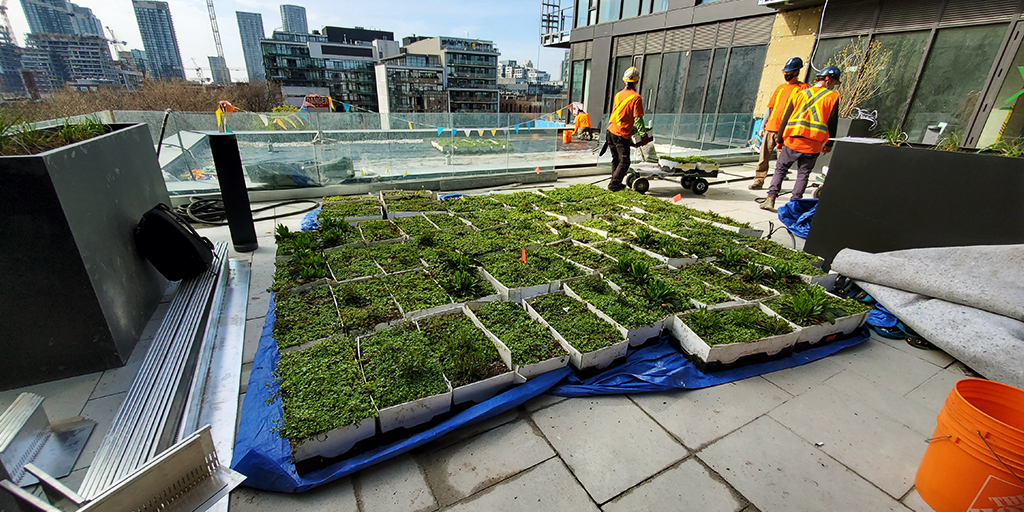
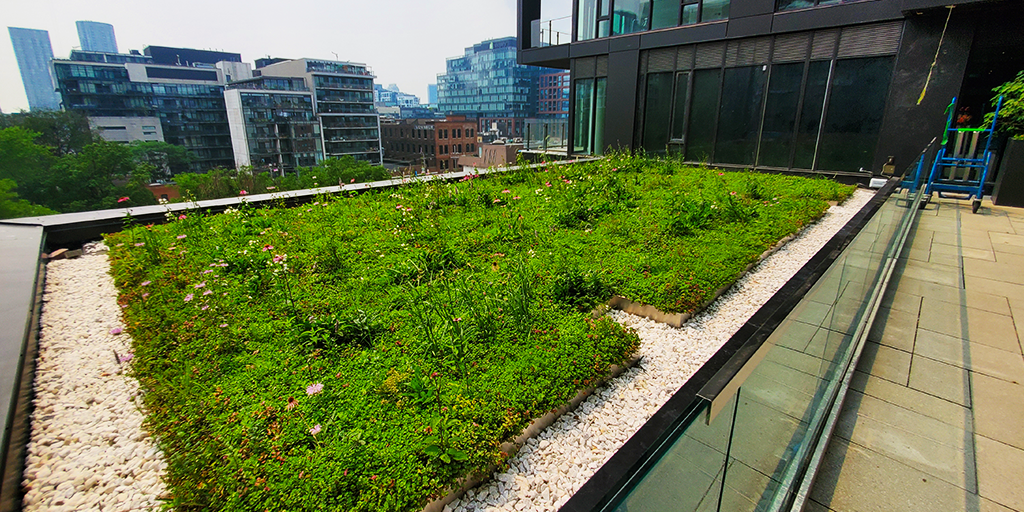
Installation of planting using modular trays on the green roof at Waterworks. (Image: JRS)
Implementation
Prior to the formal adoption of Toronto’s Green Roof Bylaw, internal requirements led to the implementation of green roofs on city-owned properties and facilities. These early applications demonstrated the City’s commitment to policy direction, and helped to establish credibility and leadership in advancing green roof infrastructure. As a result, several municipal projects, including facilities operated by the Toronto Transit Commission, became significant early precedents for green roof systems under the Bylaw. To support consistent implementation, the City provided outreach and training to planning and building staff, embedded green roof requirements into the development review processes, and provided a transitional period to allow practitioners and the industry time to adjust to the new regulatory requirements.
Toronto’s Green Roof Bylaw became enforceable through the building permit process and functioned as applicable legislation under the Ontario Building Code. Given that compliance was required before building permits could be issued, Toronto experienced an accelerated integration of green roofs in design and construction practices. To support long-term maintenance, applicants were also required to submit a maintenance plan during the permit process. Over time, amendments and exclusions were made to the policy to address unforeseen issues and practical gaps that emerged during implementation.
In response to the regulatory requirements and growing market demand, green roof projects across Toronto have increasingly demonstrated stronger integration of architecture, landscape architecture, and environmental performance objectives. Toronto’s Green Roof Bylaw intersects with other municipal policies and technical requirements, particularly those surrounding stormwater management standards. This overlap encouraged the development of more integrated blue-green roof systems that combine green infrastructure with enhanced water management capacity, illustrating how the regulatory requirements under the Green Roof Bylaw led to multi-functional and advanced roof systems.
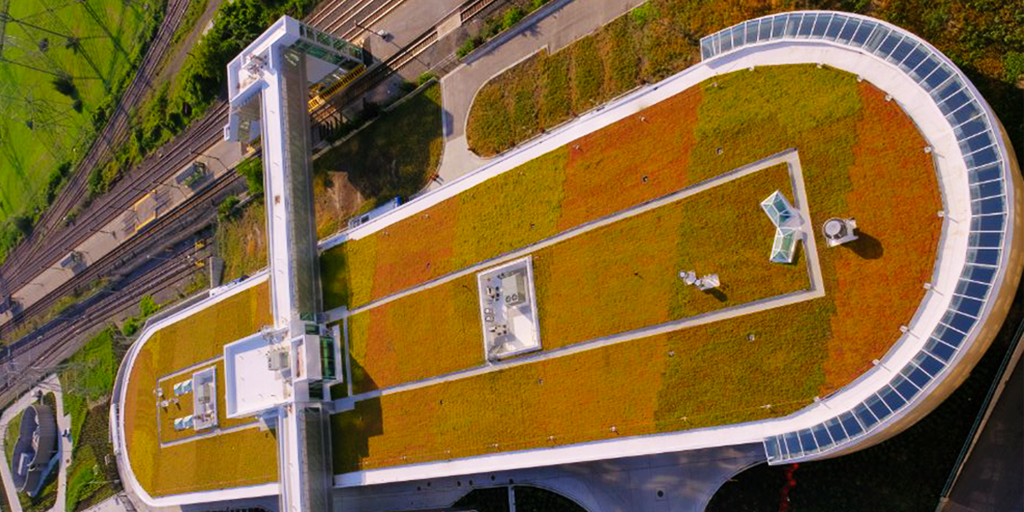
The green roof at the Kipling GO Bus Terminal (LiveRoof), represents one of the first large-scale applications of a green roof system in Toronto designed specifically around retention and detention, integrated directly into the roof structure. A collaborative effort between Strasman Architects and NAK Design Strategies (with WSP), the Kipling GO green roof incorporates modular vegetated trays to capture a significant portion of precipitation during seasonal rainfall events, while excess water during larger storms is temporarily stored within an underlying detention area before being released through controlled flow drains. This project demonstrates how green roofs evolved into more integrated, high-performance systems in response to the policy requirements, and is also notable for its location on a provincial facility within a cross-jurisdictional development context.
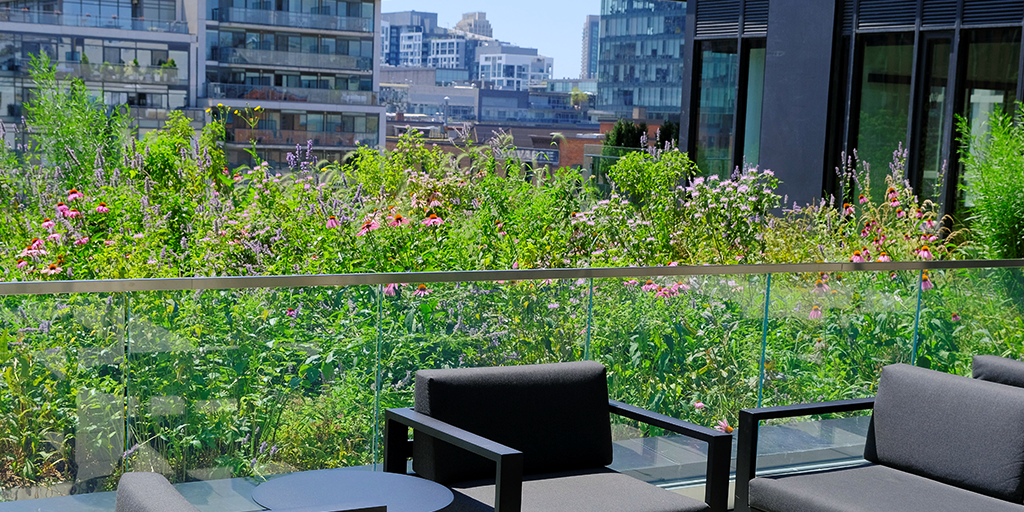
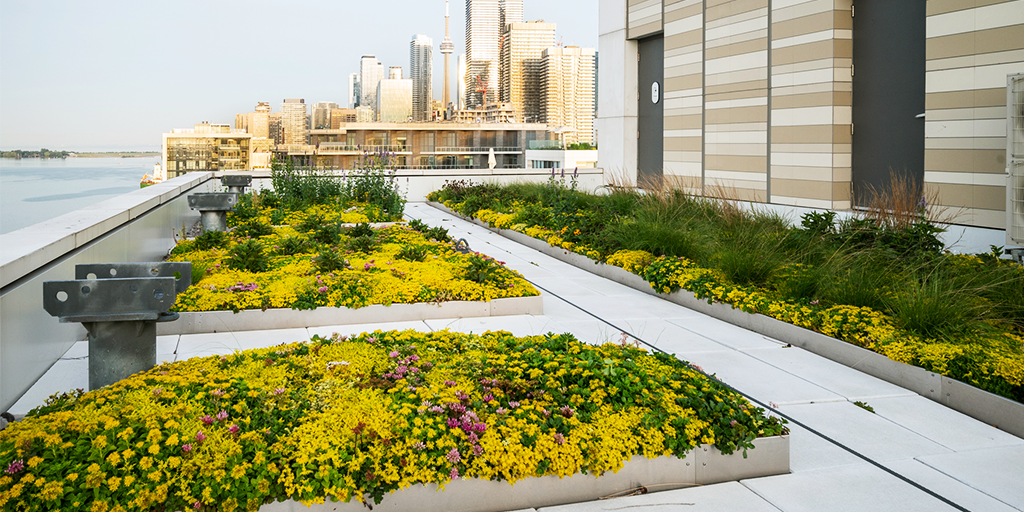
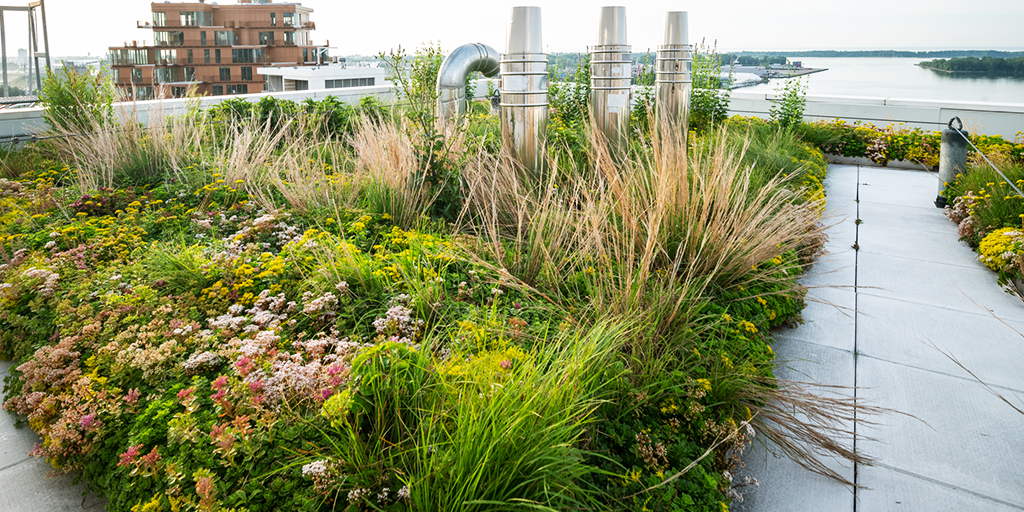
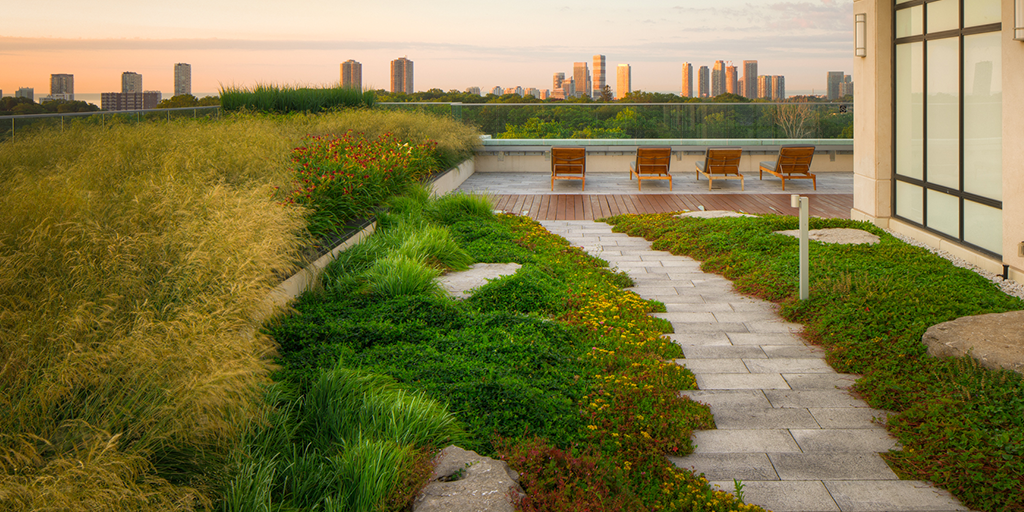
Vegetated roof systems across Toronto were increasingly designed not only to meet regulatory requirements but also to support accessible outdoor community gathering spaces, enhance biodiversity, and improve long-term maintenance and functional performance. Although many green roofs are located on privately-owned buildings, their cumulative benefits contribute to stormwater management, urban heat reduction, biodiversity recovery, and ecological services at the city-wide scale. Moreover, newer large-scale residential green roof terraces demonstrate how green roof design has evolved as social infrastructure integrating components of community amenity and landscape design, while also supporting ecological benefits. Aquabella at Bayside led by 3XN (Next Level Stormwater Management), for instance, responds directly to stormwater management requirements, and is also designed intentionally to enhance local biodiversity and support biodiversity recovery.
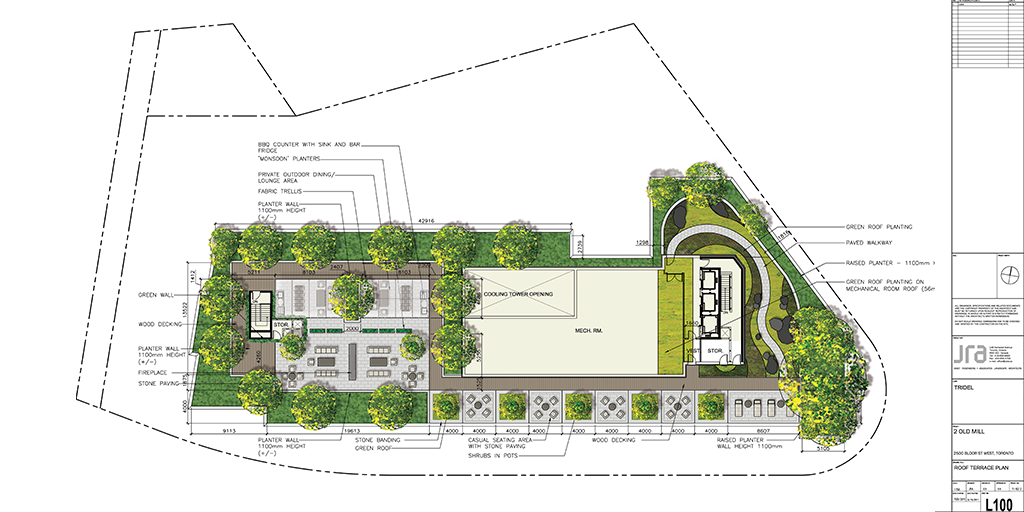
In other projects, green roof design emerges not only from stormwater management and environmental objectives, but also from the desire to create accessible amenity spaces providing residents new opportunities to engage with nature and foster community connection, tied closely to deliberate aesthetic decisions. Projects such as One & Two Old Mill (LiveRoof) led by Janet Rosenberg & Studio incorporate an integrated planting strategy, which was used to create areas of flush planting to enhance visual interest with variation of planting heights and define ‘rooms’ and pathways. Likewise, projects such as Waterworks (LiveRoof), also led by Janet Rosenberg & Studio, wrap the amenity terraces in the green roof system, incorporating an intentional planting palette of wildflowers and grasses. These projects exemplify an emerging multi-functional approach to green roof design, serving as social infrastructure as much as environmental infrastructure — supporting residential gathering and placemaking, while still delivering ecological benefits through increased habitat value and biodiversity.
In similar ways, emerging projects such as the University of Toronto’s Indigenous House (Next Level Stormwater Management) reflect the broader integration of environmental performance and landscape design with cultural programming. Led by Formline in consultation with PUBLIC WORK, Indigenous House (to be completed in spring 2026) will incorporate green roof systems and landscape features such as gathering spaces, learning gardens, and Indigenous medicinal and spiritual gardens, using a planting palette developed collaboratively with Next Level Stormwater Management, specifically for this project, comprising a mix of native and pollinator plantings as well as resource species traditionally used for food and craft. Also notable for its steep slope and complex form – which incorporates a meadow mat over a cable-hung webbing system – Indigenous House will advance both education and delivery of ecological benefits and climate-responsive design, while creating new opportunities for cultural uses and Indigenous teachings in an institutional setting.
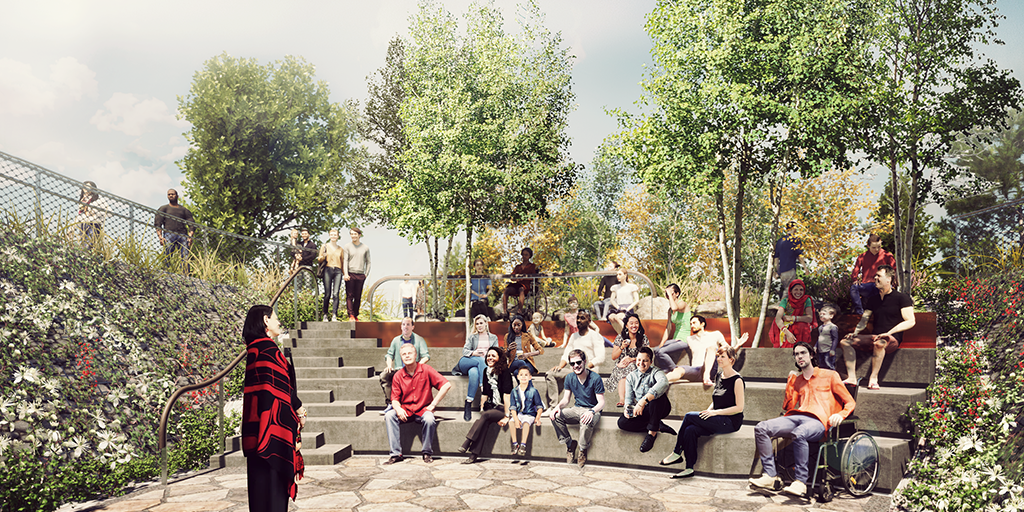
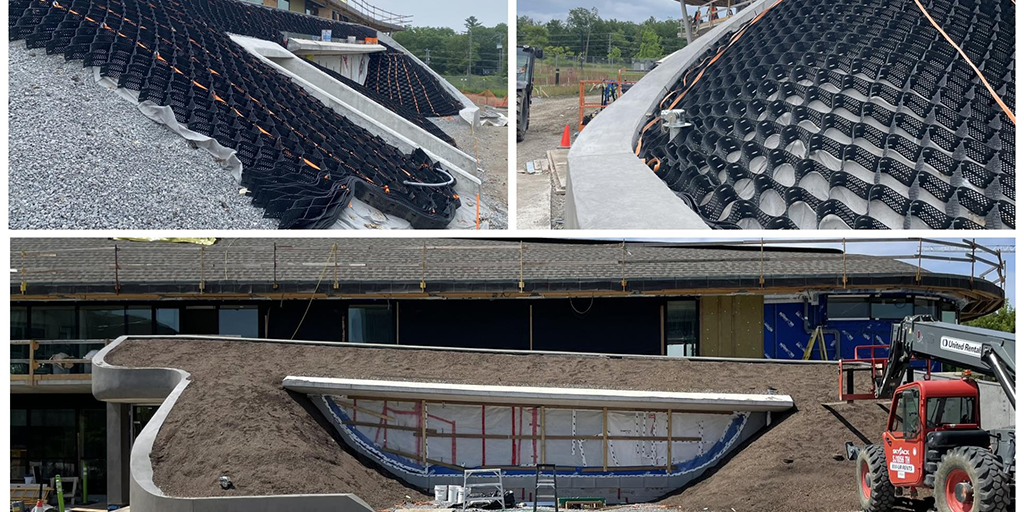
Indigenous House at the University of Toronto: Sunken garden area render (left); Cable-hung slope reinforcement system for meadow mat installation (right). (Image: PUBLIC WORK)
Outcomes and Monitoring
Between 2010 and 2025, Toronto’s Green Roof Bylaw supported an estimated $50 million green roof design and construction industry and resulted in the installation of more than 1,200 green roofs across the city. In 2025, the University of Toronto conducted a remote sensing study, which indicated that most green roofs constructed under the Green Roof Bylaw remain in place and are generally in good condition, thus demonstrating the long-term durability and performance of projects delivered. The successful delivery and maintenance of these projects under the Bylaw illustrate the positive impacts of evidence-based regulation in shifting market behaviour and stimulating industry growth when supported by consultation and a strong implementation framework. More broadly, the Bylaw underscored the benefits of policy-driven adoption of green infrastructure to advance climate resilience and improve professional practice across design fields.
Highlights of the Landscape Architect
As uniquely qualified professionals at the intersection of ecology, design and planning, landscape architects were central to the policy drafting process of Toronto’s Green Roof Bylaw, playing a pivotal role not only in project delivery, but in shaping the policy and the technical standards that guided it. In addition to the landscape architects at the City of Toronto, the Ontario Association of Landscape Architects (OALA) participated as part of the City’s Technical Advisory Committee to provide expert input during the development of the Green Roof Construction Standards. While this was a collaborative process, the profession of landscape architecture brought a distinct and essential perspective grounded in technical rigor and ecological systems thinking. This direct involvement helped ensure that the requirements reflected practical design considerations and emerging best practices in green roof project delivery, while establishing effective and implementable strategies to address climate-related challenges such as stormwater management and biodiversity recovery, and advance climate resilient and adaptive city building.
Beyond policy development, landscape architects were central to advancing ecological design approaches and integrating green roof systems within broader site planning, as demonstrated by projects delivered under Toronto’s Green Roof Bylaw. Their expertise in design, hydrology, and ecology supported the development of integrated green roof construction, advancing both environmental performance and community-building objectives through the creation of rooftop landscapes. While collaboration between landscape architects, architects, engineers, and green roof suppliers was critical for successful delivery, close coordination between landscape architects and suppliers in particular, supported innovation and the refinement of installation practices as the local industry evolved in Toronto. Throughout these projects, landscape architects worked closely with green roof suppliers, and their collaborative efforts guided practical design standards such as plant communities suited to growing media conditions, as well as the development of specialized products including biodiverse and blue-green roof systems. In a similar way, collaboration with strong internal municipal and external champions was also essential to the successful delivery of the green roof projects, and more broadly to the successful adoption of the Bylaw itself. The outcomes of Toronto’s Green Roof Bylaw demonstrate that landscape architects are central in bridging policy and practice, translating environmental objectives into clear, evidence-based design standards to advance effective climate-focused regulation.
Next Steps
As of November 2025, via Bill 60, the Fighting Delays, Building Faster Act, 2025, the Ontario provincial government repealed the authority for the City to enforce the Green Roof Bylaw. As a result, the regulatory framework is no longer in effect, and the City can no longer require green roofs or enforce compliance for new large-scale commercial, institutional, and residential developments, making green roofs voluntary for new developments. Despite this shift, green roofs continue to be implemented in Toronto, primarily to meet stormwater management requirements under other applicable regulations and development processes. The City continues to require green roofs on its own facilities as part of its internal sustainability commitments and broader environmental objectives, and green infrastructure remains a central component of climate resilience strategies, even without the bylaw in effect.
Beyond green roof projects, the City of Toronto is also investigating broader decarbonization initiatives for the public realm, including evaluating the carbon impacts of parks, streetscapes, and rights-of-way construction. In 2025, the City completed a Landscape Carbon Benchmarking Study, which has helped to inform the Low Carbon Landscape Design Guide to strengthen professional capacity and embed carbon-informed decision-making into planning practice. Additional studies and policy initiatives are also underway to support and continue the implementation of green infrastructure and to align landscape design with evolving climate adaptation and mitigation priorities. Together, these efforts demonstrate that while regulatory tools may change, commitments to climate action and environmental objectives through green infrastructure integration continue to evolve within Toronto’s municipal practice.
Resources
- C40 Cities (2018) – City of Toronto's Eco-Roof Incentive Program and Green Roof Bylaw
- City of Toronto – Eco-roof Incentives Program
- City of Toronto – City of Toronto Green Roof Bylaw
- City of Toronto – Green Roof Overview
- City of Toronto – Guidelines for Biodiverse Green Roofs
- CBC News (Draaisma, 2025) – Ontario's scrapping of Toronto's green roof bylaw has opposition MPPs, advocates seeing red
- Living Architecture Monitor: A Green Roofs for Healthy Cities Publication (Peck, 2025) – Upheaval and Innovation: The Legacy of Toronto’s Green Roof By-Law and the Threatened Green Standards
- Living Architecture Monitor: A Green Roofs for Healthy Cities Publication (Liu, 2026) – Sky-High Returns: The Economic and Social Case for Green Roof Amenity Space
- Toronto Metropolitan University (formerly Ryerson University) (2005) – Report on the Environmental Benefits and Costs of Green Roof Technology for the City of Toronto

This case study was prepared and authored by Sabrina Careri (Design Communications) on behalf of the CSLA.
It forms part of the landADAPT Case Study Series, an educational resource and advocacy tool developed by the CSLA with the support of Natural Resources Canada’s Climate Change Adaptation Program.