


Trails & Tribulations
Query/Drafts Deadline: June 15, 2026
Final Article Due Date: July 6, 2026
Guest Editors: Patrick Beech + Daniel Scott
Editorial Board Liaison: Kevin Fraser
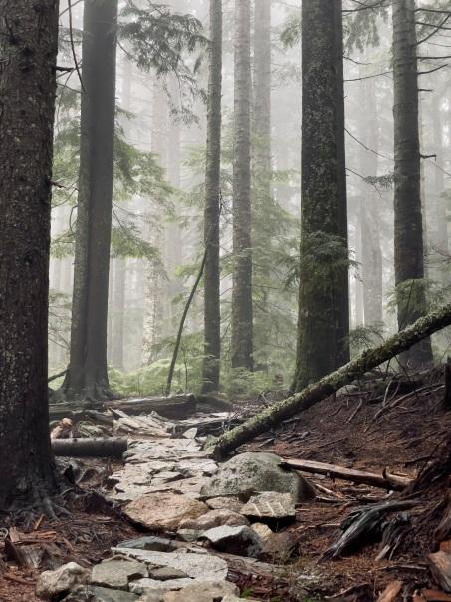
“Do landscape architects do trails?” Co guest editor Patrick Beech was recently asked this question by a group of MLA students while presenting one of his firm’s projects. They were intrigued but skeptical, as trails aren’t a focal point of the curriculum.
In their simplest form, trails may reflect desire lines: repeatedly travelled routes that reveal the most efficient path. These may appear as “deer trails” in nature and as pathways worn across a snow covered plaza in urban settings. At their most elemental, trails arise organically without planning or design interventions. Trails evoke many intriguing contradictions that warrant exploration. They are places where we connect with nature and spend our precious leisure time. They may instill a sense of stewardship, yet trail impacts on ecosystems are raising growing concerns.
We use some trails to get from A to B, though many of the best trails simply lead back to where they started. Trails are places to push ourselves and test our endurance but also have the capacity to protect and restore our physical and mental health. Trails are fundamentally analogue experiences, yet social media driven popularity and other disruptive technologies are some of today’s most challenging issues for land managers. Trails are among the most enduring features of a landscape, as evidenced by millennia old Indigenous heritage routes, yet in some areas they just appear, unauthorized, seemingly overnight.
Landscape architects and allied professionals are indeed in the business of planning and designing trails, which can be surprisingly complex projects. Successful trail planning requires rigorous study and consideration of how people (and perhaps other life forms) move through space, site hydrology and the integration of natural and built features. Trails present many technical and operational challenges and are frequently affected by critical issues facing the profession, from climate change and reconciliation to equality and our relationship with nature. Our efforts are frequently informed by extensive public engagement and careful planning by multidisciplinary teams including engineers, biologists, arborists, archaeologists and others.
For this issue of Landscapes | Paysages, we invite you to submit articles exploring the current and future roles of landscape architects in trail planning and design. Consider the following prompts for a range of potential topics:
- As trail design and construction become increasingly professionalized or specialized, what are your experiences with this transition?
- What role are stewardship groups and trail associations playing in trail networks?
- How are trail planners and designers navigating sensitive ecosystems and the effects of trail users on wildlife?
- How are planners and land managers improving access to trails and nature for underserved groups?
- How are Indigenous communities using trails to connect with their lands and culture?How is the growing awareness of the role of access to nature in public health changing approaches to trails?
- How is climate change affecting trails? How are planners and designers responding?
- Trails sometimes span long distances and multiple jurisdictions. Do you have a story about the partnerships and collaboration needed to make this happen?
- How is technology changing practice or shaping trail use? What innovations are landscape architects using?
- What innovative management and maintenance approaches for trail networks are you using? What challenges are you facing?
Please send article ideas, abstracts, or drafts to:
Guest Editors:
Patrick Beech, pbeech@elac.ca;
Daniel Scott, daniel.scott@gov.bc.ca
OR, Managing Editor: Laurie Blake, lp@csla-aapc.ca
General Guidelines for Contributors
We welcome a range of formats, including:
- Feature Articles: In-depth explorations of 1,200–1,500 words.
- Prologue Articles: Short reflections or provocations of 300–500 words.
- Case Studies: Examples of projects that integrate playful concepts.
- Interviews: Conversations with practitioners, policymakers or academics or those with something to contribute to the topic.
- Visual Content: Infographics, maps and other visuals that illustrate the topic.
- Illustrations: Supply 10-12, high-resolution images (300 dpi) for feature articles and 2-3 for shorter pieces, with captions and photo credits. Further photo guidelines available upon request.
Biography
- Please provide a brief bio (around 50 words), a photograph, your preferred email address and a mailing address (for complimentary copies). Our authors are the voice of LP, and our readers appreciate knowing where you are coming from. In your brief bio, please DO include a mention of your work or home base – but please keep the data brief. Instead, we invite you to use the space to tell us something about yourself, and your link to the story you are telling in the magazine, or to the issue’s theme.