


Colleen Mercer Clarke's Lecture at the University of Guelph on why nature plays an important role in our changing world, and what landscape architects can accomplish towards reducing emissions, sustaining nature, and improving well-being.
CSLA Resource Library
Welcome to the CSLA Resource Library! Explore a wide range of landscape architecture-related research, reports, tools, videos and more—searchable by keyword, topic or type.
Have a resource you'd like to see included? Contact our team to share your suggestion.
The Value of Nature in a Changing World.. how you can make a difference
2021 – Webinar

University of Guelph
AILA Climate Positive Design Guidelines. Volume 2. Organisation guide to Climate Positive
2021 – Paper

AILA
AILA’s Climate Positive Design Series will help guide your climate positive journey, we have three separate documents, targeting three specific areas of our work and practice. Volume 2 outlines the steps your practice, business or organisation can take to achieve carbon neutral certification and beyond to become climate positive.
AILA Climate Positive Design Guidelines. Volume 3 AILA roadmap to delivering climate positive design
2021 – Paper

AILA
AILA’s Climate Positive Design Series will help guide your climate positive journey, we have three separate documents, targeting three specific areas of our work and practice. Volume 3 sets the framework, guidance and time frames for the AILA Executive and State groups to roll out climate positive design to members, and provide engagement and policy direction.
AILA Video Series: climate positive design short explainers
2021 – Webinar

AILA
"AILA’s Climate Positive Design Video Series will help guide your climate positive journey. Watch the climate positive design short explainers, on:
- What does climate positive design mean?
- How to measure your projects carbon.
- One big tree is worth a thousand small trees.
- Understanding carbon drawdown
- Understanding greenhouse emissions
- Advocacy
- Top Six Things you can do
- Mitigation toolkit
- Calculating your greenhouse emissions (custom elements)"
AILA Climate Positive Design Guidelines. Volume 1 Climate positive design action plan for Australian landscape architects
2021 – Paper

AILA
AILA’s Climate Positive Design Series will help guide your climate positive journey, we have three separate documents, targeting three specific areas of our work and practice. Volume 1 provides clear, simple advice on what Australian landscape architects can do to understand and deliver climate positive design through good planning, design, documentation, construction and renewal.
Nature-Based Solutions by Design
2021 – Paper

CSLA/AAPC
The CSLA believes that NbS offer innovative opportunities to meaningfully address multiple sustainability crises (e.g., climate change, food and water security, land degradation, loss of biodiversity, human well-being, and natural disasters).
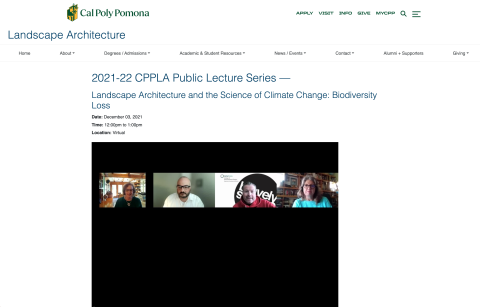
Landscape Architecture and the Science of Climate Change: Biodiversity Loss
2021 – Webinar
CCPLA
The Department of Landscape Architecture at the California State Polytechnic University: Part of a series of talks on “Landscape Architecture and the Science of Climate Change”, pairing the research of scientists with the implementation of landscape architects on climate change topics.The third installment of the 2021-22 public event program "BIODIVERSITY LOSS " presents talks by Isaac Brown, MLA, Ph.D., Senior Scientist at Stillwater Sciences; and Pamela Galera, RLA, ASLA, City of Riverside’s Director of Parks, Recreation, and Community Services.
CSLA Statement on Reconciliation and the Profession of Landscape Architecture
2020 – Paper

CSLA/AAPC
The statement is based on input gathered from an environmental scan of CSLA provincial, regional and territorial component associations, universities, related professional associations, Indigenous organizations and practitioners, and CSLA members. The CSLA acknowledges and appreciates the invaluable contributions provided by the RAC and member volunteers who participated in the environmental scan research.
Landslide 2020: Women who Shaped the American Landscape
2020 – Case Study

TCLF
Women who Shaped the American Landscape highlights cultural landscapes from around the nation that were designed by or are associated with women. Many of the places featured in this year’s thematic report are nationally known for their historical and cultural significance. However, their associations with women may be unrecognized, leaving these important legacies under threat. Taken together, these sites highlight the significant roles of women in designing the world around us. This year’s report emphasizes the importance of honoring women’s landscape architecture work so that these sites survive into the future for the enjoyment of the public.
Heat Waves and Health
2019 – Paper

Prairie Climate Centre
Many Canadians welcome the arrival of hot summer days as respite from our long, cold winters. But too much heat can be dangerous. There’s no doubt that with climate change we’re going to see more heat waves. Even temperate coastal cities such as Vancouver are preparing for extreme heat impacts. This report takes a look at what extreme heat means for the health of Canadians.
Playbook for the Pyrocene
2019 – Tool

SWA
Historically, wildfire planning has been largely focused on two scales: site-scale solutions to hardening houses and yards, and large-scale, macro shifts in fire regimes. In response, “Playbook for the Pyrocene” focuses on community-scale solutions, synthesizing concepts from a range of related disciplines including ecology, fire science, forestry, land use planning, emergency management, and indigenous stewardship. Among the book’s findings are six broad guidelines and 20 applied strategies to reduce wildfire risk at a community scale—presented in an illustrated guide intended for a broad audience without specialized expertise. An additional appendix serves as a more comprehensive repository of topical resources, guidelines, best practices, and empirical research related to each strategy.
Climate Atlas Guidebook
2018 – Tool

Prairie Climate Centre
The Climate Atlas of Canada (climateatlas.ca) is an interactive tool for citizens, researchers, businesses, and community and political leaders to learn about climate change in Canada. The articles, maps, and videos in the atlas tell a compelling story: climate change is here, it’s a serious challenge, and we can take action. The atlas can help you make sense of climate change, and this guidebook will help you make sense of the atlas. First we’ll explain how to find different kinds of information in the atlas. And then we’ll give you some help figuring out what it all means.