


The Adaptation Primers are just that – introductory books that provide basic information on the most complex challenge facing decision-makers in this first half of the 21st century. Primer Three provides an overview of the opportunities to create resilient communities that enhance public well-being, integrate nature, and ensure a prosperous future.
CSLA Resource Library
Welcome to the CSLA Resource Library! Explore a wide range of landscape architecture-related research, reports, tools, videos and more—searchable by keyword, topic or type.
Have a resource you'd like to see included? Contact our team to share your suggestion.
The adaptation primers* Primer 3: creating resilient communities
2018 – Paper

CSLA/AAPC
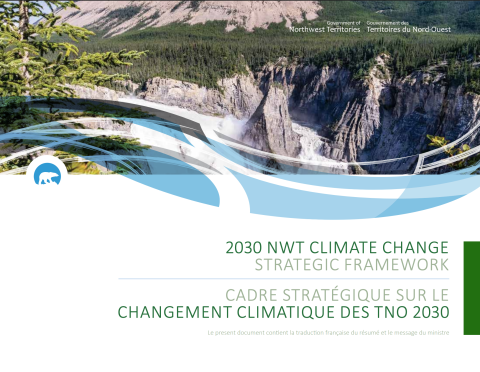
2030 NWT Climate Change Strategic Framework
2018 – Paper
Government of the Northwest Territories
"The 2030 NWT Climate Change Strategic Framework 30
is a long-term plan to reduce greenhouse gas emissions by 30% from 2005 levels, improve understanding of climate impacts, and strengthen resilience in communities and ecosystems. Supported by a detailed action plan and aligned with the 2030 Energy Strategy, it promotes renewable energy, energy efficiency, and adaptation measures, and is regularly updated through public and Indigenous engagement."
Smart Policies for a Changing Climate
2017 – Paper

ASLA
Climate change is intensifying the negative impacts of standard development practices and putting people and communities at risk. We need a new paradigm for building and enhancing communities that works in tandem with natural systems and considers the needs of all. To meet that goal, ASLA’s interdisciplinary Blue Ribbon Panel on Climate Change and Resilience identified the following core principles, key planning and design strategies, and public policies that will promote healthy, climate-smart, and resilient communities.
PATHWAYS TO RECONCILIATION: Cities respond to the Truth and Reconciliation Commission Calls to Action
2016 – Paper

FCM
Cities respond to the Truth and Reconciliation Commission Calls to Action. This guide captures the journey on the pathways to reconciliation. It is a tool meant to help share, sustain and grow our efforts. Reconciliation is truly a national process that will require tremendous efforts by all Canadians―and across all orders of government.
Resilient, Transformative and Sustainable: A Positive Approach to a Changing Future
2016 – Paper

CSLA/AAPC
The CSLA believes that by working across environmental and cultural systems, landscape architects are uniquely positioned to engage professions, industries and governments in new alliances better equipped to innovatively address complex social and ecological problems and to fully express the opportunities inherent in principles of equity, sustainability, resiliency and democracy.
Adapt-action tool
2014 – Tool
Miistakis Institute
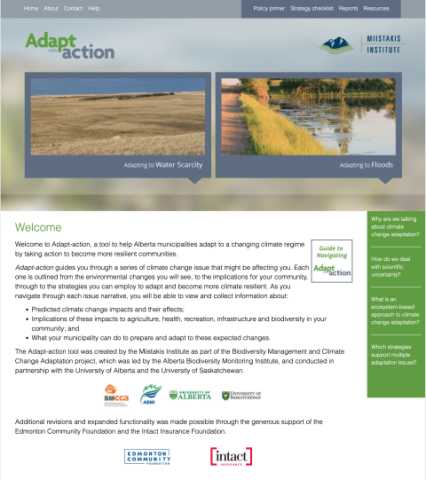
The Adapt-action tool helps Alberta municipalities address climate change by highlighting key impacts like water scarcity and flooding and offering practical adaptation strategies. Developed by the Miistakis Institute, it provides resources such as checklists and policy guides to support local climate resilience planning, with a focus on ecosystem-based approaches.
Landscape Architecture in Canada Video Series
2014 – Presentation

CSLA/AAPC
This series of five videos celebrating the history of landscape architecture in Canada was launched in celebration of the CSLA's 90th anniversary.
Alberta’s Climate Change Adaptation Framework (CCAF)
2010 – Paper
Government of Albert
The Climate Change Adaptation Framework Manual from Alberta outlines a five-step process for organizations to assess climate risks and develop adaptation strategies. It guides integrating climate considerations into planning to improve resilience and manage climate impacts effectively.
Standards and Guidelines for the Conservation of Historic Places in Canada
2010 – Tool

Canada's Historic Places
The Standards and Guidelines for the Conservation of Historic Places in Canada is the first-ever pan-Canadian benchmark for heritage conservation practice in this country. It offers results-oriented guidance for sound decision-making when planning for, intervening on and using historic places. This document establishes a consistent, pan-Canadian set of conservation principles and guidelines that will be useful to anyone with an interest in conserving Canada's historic places.
United Nations Declaration on the Rights of Indigenous Peoples
2007 – Paper

United Nations
The United Nations Declaration on the Rights of Indigenous People UNDRIP was adopted by the general assembly in 2007. In 2021, it was signed into law in Canada through the passage of Bill C-15, which became the United Nations Declaration on the Rights of Indigenous Peoples Act. The Act explicitly confirms that the UN Declaration can be used to interpret Canadian laws — Canadian courts have already been using the UN Declaration in exactly this way.
Climate Change Connection
2002 – Page web
Manitoba Climate Change and Sustainability Partnership
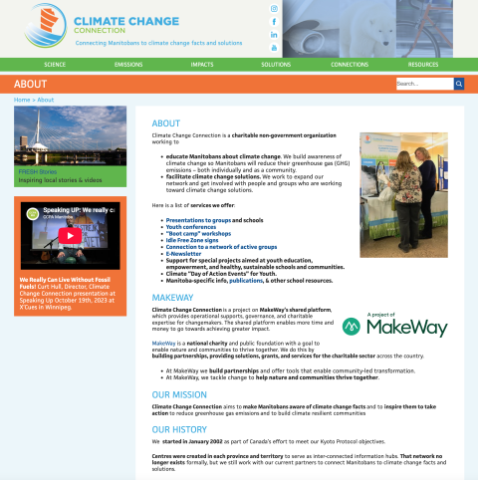
The Climate Change Connection is a Manitoba-based educational platform run by the Manitoba Climate Change and Sustainability Partnership. It provides accessible, science-based information, tools, and resources to help Manitobans understand climate change, its local impacts, and adaptation strategies, supporting informed decision-making and community resilience.