


QUICK FACTS:
Name
Halifax Public Gardens
Type of Landscape
Garden parkland in an urban setting
Location
Halifax (Spring Garden Road + Summer Street), NS
GPS 440 38’34”N; 630 34’56”W
Owner
Halifax Regional Municipality
Legacy
Rare intact Victorian Public Garden
Designated a National Historic Site (1984)

Introduction![]()
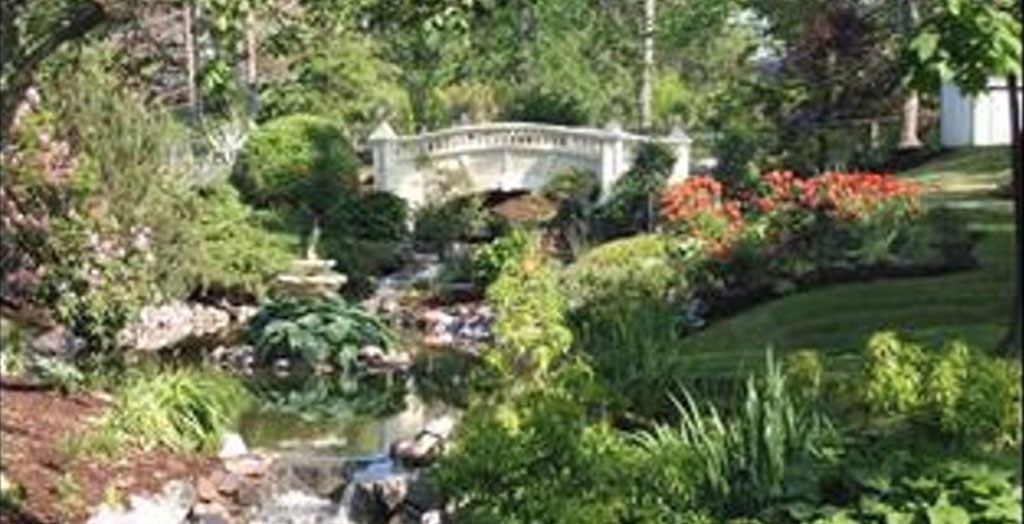
The Halifax Public Gardens Historic Site is an exceedingly rare, High Victorian period piece, a 19th century pleasure garden which still flourishes, intact, in the heart of Nova Scotia’s sea-side capital city.
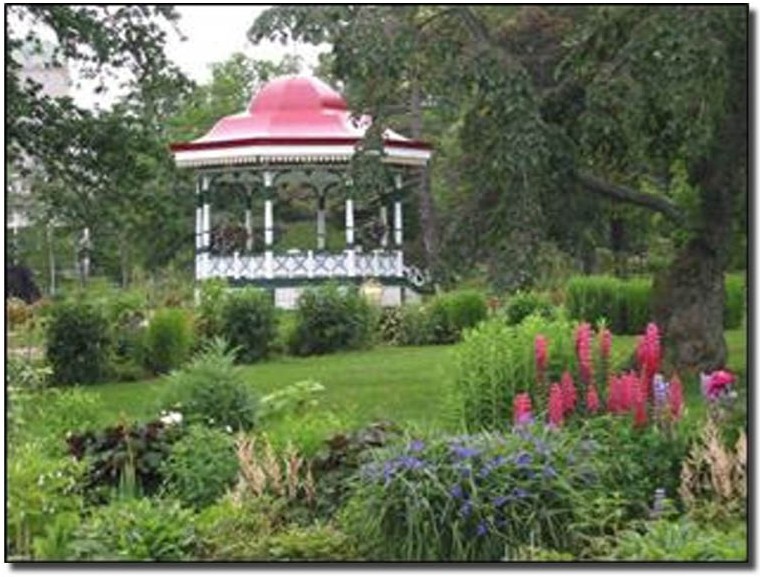
The Gardens are, in essence, a botanical composition with a Victorian soul. Streams and watercourses traverse the grounds. The wooded groves are graced by exotic foliage, statues of goddesses, wrought-iron gates and ages-old specimen trees. Fountains and bridges draw the eye, and in classic Victorian fashion, an octagonal bandstand commands the garden’s sunniest spot. Installed to honour Queen Victoria’s Golden Jubilee in 1887, the bandstand was – and still is -- surrounded by 32 geometric beds of brilliant annual bloom.
The horticultural exuberance on display is a gift crafted by early Haligonians, a community with an unbounded interest in science, and a sound belief in the restorative powers of nature for everyone, city labourers and higher classes alike.
The gardens took root when the city added neighbouring parkland to the Nova Scotia Horticultural Society Garden, laid out on the Halifax Common in 1837. The larger garden soon became “a delightful retreat.” With another expansion in 1872, the city hired Richard Power to manage and harmonize the grounds.
Power, who aimed at nothing less than Victorian perfection, would serve as the gardens’ visionary supervisor until 1915. In the Gardenesque tradition of John Claudius Loudon, he believed a garden was itself a work of art. Power took great care in the selection of exotics, sub-tropicals and tree species. He set them to be admired individually, creating picturesque Victorian settings throughout the immaculately groomed grounds.
Today, his vision endures. The gardens weathered natural change and robust urban growth to become a National Historic Site in 1984. Then, following Halifax’s devastating hurricane of 2003, the city engaged landscape architects to direct the restoration of the Gardens to their original, 19th century glory.
Power and the “state of perfection”
Foreman gardener Richard Power, “the guiding spirit” of the Halifax Public Gardens, entered the employ of Halifax City in 1872. Since the grounds had grown to 6.5 ha (18 acres), his first task was to meld the park into a harmonious, symmetrical whole.
For the botanically passionate Nova Scotia Horticultural Society, a man of Power’s practical ability and vision was the ideal superintendent. He trained in Ireland with Sir Joseph Paxton, the forward-thinking designer responsible for Britain’s first municipal park. Later, he joined Messrs Olmsted and Vaux in New York’s Central Park.
After just three years under Power’s supervision, the Gardens staged a formal reopening to great public acclaim. The gardens, said the locals, had become “a resort for all the wealth and fashion of the time” relieving the stresses of the city life for all Haligonians.
During Power’s 42-year tenure, his passion for horticultural techniques and the tropes of the Victorian High Garden continued unabated. His careful plant selection featured semi-tropicals, exotic trees and shrubs, including conifers especially prized by Victorians. He designed picturesque settings for prize specimens, adding bridges, ornate wrought iron gates and sculpted goddesses to the grounds. In 1897, once again in honour of Queen Victoria, Power installed a fountain to mark her Diamond Jubilee.
Power continued the planting traditions of the era. He oversaw the transformation of Griffin’s Pond from a square to a miniature lake, added a conservatory, a pavilion, and a new lodge. Every year, he bedded out annuals in highly designed carpet beds of brilliant flowers, a tradition that remains today.
A century and a half later, the Halifax Public Gardens still exude Victorian charm. Astonishing numbers of Power’s species and varieties are still present, the Gardens are still a sanctuary for native birds, and well beyond their gates, the Gardens have supplied thousands of trees that beautify city streets.
After the hurricane: 200 years of “charming excellence”
In September of 2003, Hurricane Juan hit Halifax head on, uprooting trees and wreaking havoc in the Public Gardens. In its wake, the landscape architectural firm Vollick McKee led an interdisciplinary design team to rehabilitate the well-loved space.
The team worked on a challenging accelerated schedule. They focused first on the pragmatics of restoring the pathways, solving drainage issues, while reconfiguring the many pools and waterfalls of the watercourses. To the relief of Haligonians across the city, the Gardens’ gates reopened on Canada Day, 2004.
But with the shock of the hurricane’s devastation, the city more keenly recognized the rare value of their Gardens. It was time to take stock. Halifax commissioned Vollick McKee to comprehensively restore the centuries-old design. The job included identifying any incompatible additions made over the decades, and restoring missing elements present in the Gardens’ Victorian glory days. Since modernization would be necessary, the designers were challenged to weave modern amenities into the fabric of the garden.
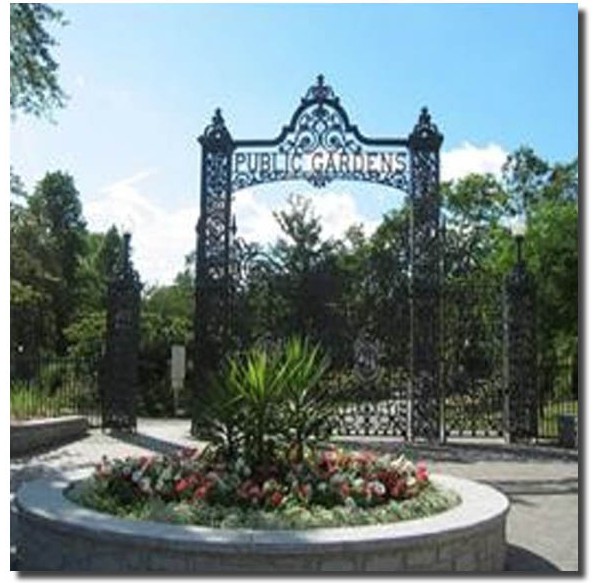
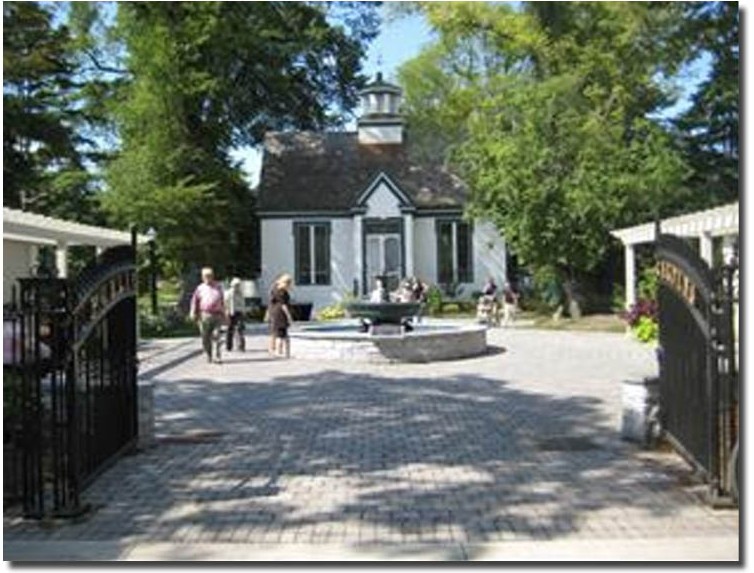
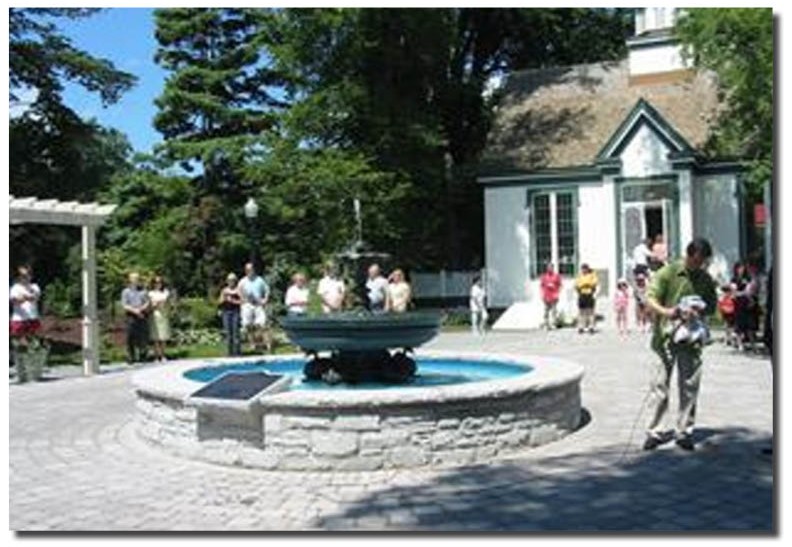
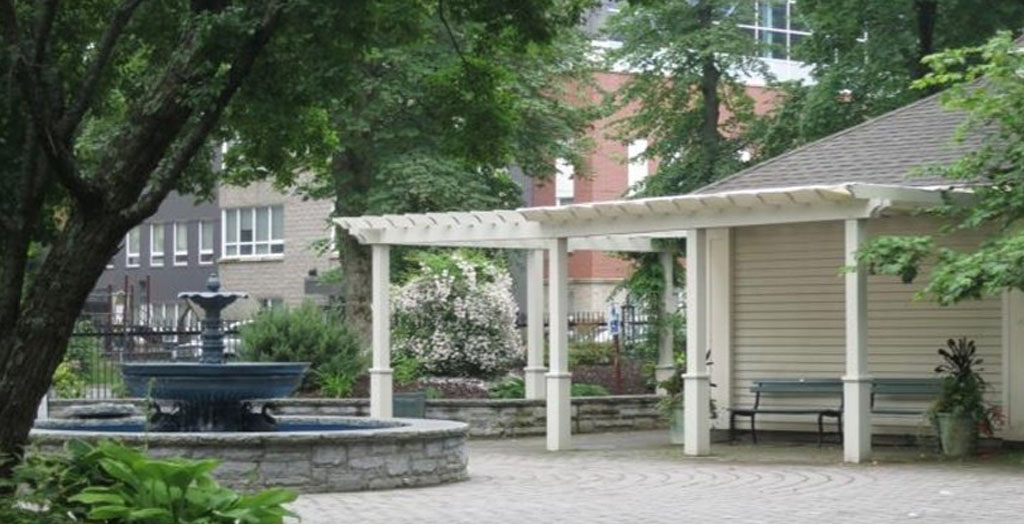
To restore key elements of the original design, the team ambitiously recreated the natural course of the Gardens’ original stream. As well, the teams reconstructed the rooftop cupola of the historic Horticultural Hall, added a deck/terrace, developed an interpretive area and coffee shop, and added a new cast-iron fountain. Visitor facilities became better lit and barrier-free. The expanded entry plaza can now deal with the increased bus traffic, befitting a National Historic site, and the designers seamlessly blended the new entry gate with the Gardens’ century old Scottish cast-iron fencing.
| 
|
Today’s gardens are still united and traversable by a system of gently curving gravel pathways, and enclosed by a perimeter of mature trees and wide sidewalks which act as buffers between the park and the surrounding city.
The verdict? The “charming excellence” the early Haligonians wanted to see, is more authentically ‘Victorian’ today than it has been for most of the last century.
In the words of the Victorians of Halifax
The Journal of Garden History, circa 1983, explains why “citizens of prominence” gave their time, resources and abilities to build the Gardens.
Firstly, such a garden would contribute to the good physical and mental health of the labouring classes by providing an open space in which they could walk with their families. Secondly, a collection of botanical specimens, properly arranged, would appeal to the higher classes who could stroll among the plantings with their ladies and discover plenty of material for polite discourse. And, thirdly, such an institution would promote ‘the worth of country’ and in doing so, instill a sense of patriotism. This, they believed, should appeal to the politicians.
The Halifax Victorians’ service to the cause, said the Journal, was “a service of love, the giving of innocent and healthy pleasure to succeeding generations.”

The Cultural Landscapes Legacy Collection highlights the achievements that have made a lasting impact within the field of landscape architecture and on communities across Canada.